
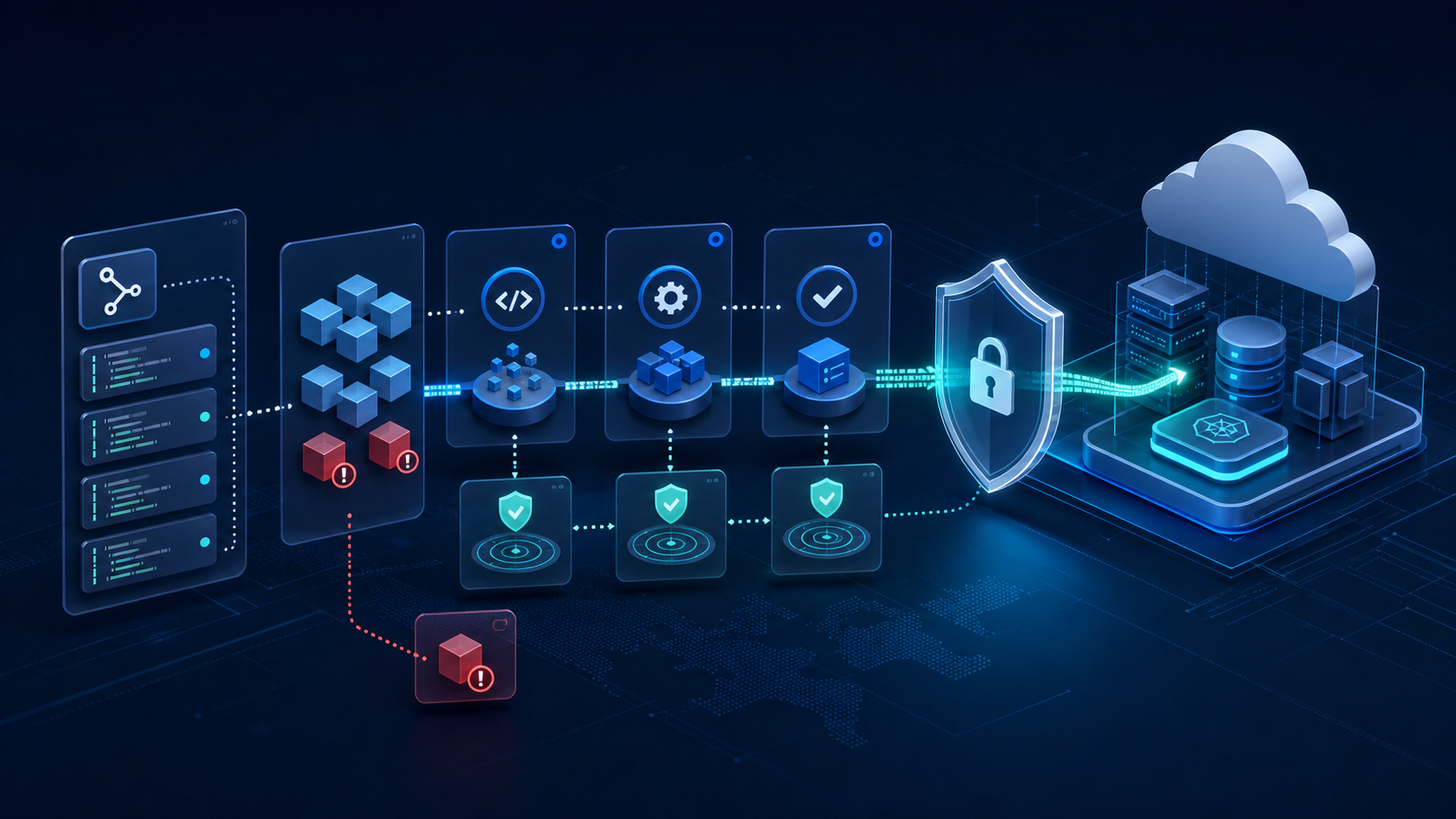
Trivy is supposed to help teams find risk, not introduce it. That is why the latest update around the Trivy supply-chain compromise matters: a trusted security tool used in build pipelines and developer environments was itself abused in a credential-stealing campaign.
CISA added CVE-2026-33634 to its Known Exploited Vulnerabilities (KEV) catalog on March 26, 2026, confirming that the issue is not theoretical. For businesses that rely on CI/CD automation, this deserves immediate attention.
What happened
According to the NVD entry for CVE-2026-33634 and Microsoft’s security analysis, a threat actor used compromised credentials to push malicious changes into official Trivy distribution channels on March 19, 2026. The incident affected the Trivy binary version 0.69.4 as well as the aquasecurity/trivy-action and aquasecurity/setup-trivy GitHub Actions.
The dangerous part is not just that malware was inserted. It is that the attacker abused trusted release and tag mechanisms that many teams assume are safe. In practical terms, organizations could have pulled a malicious security-scanning component directly into their pipelines without making any obvious change to their workflow definitions.
Why this threat matters to businesses
Supply-chain attacks against developer tooling hit a different layer of the organization’s risk surface.
- They target trust. Security tools, build runners, and deployment workflows often have broad access by design.
- They threaten secrets. If CI/CD systems are compromised, attackers may gain access to cloud credentials, SSH keys, API tokens, database secrets, and internal repositories.
- They can spread quietly. A poisoned pipeline can look normal while still collecting and exfiltrating sensitive data.
Microsoft reported that the malware observed in the Trivy campaign performed host fingerprinting, dumped environment variables, attempted to access cloud metadata services, harvested Kubernetes and CI/CD secrets, and exfiltrated stolen data while allowing the legitimate scan to appear successful.
Who is most exposed
This threat is especially important for organizations that:
- Run GitHub Actions or self-hosted runners in production delivery pipelines
- Use Trivy in automated container, image, or infrastructure scans
- Reference third-party GitHub Actions by mutable version tags instead of full commit SHAs
- Store privileged credentials in CI/CD environments with broad access
Managed service providers, software teams, DevOps-heavy organizations, and businesses with fast release cycles should treat this as more than a developer-side issue. It is an operations and security issue.
What IT and security teams should do now
- Verify whether your organization pulled or executed Trivy v0.69.4 or affected GitHub Action tags during the exposure window.
- Move to known safe versions immediately. Public guidance points to safe versions including Trivy v0.69.2 to v0.69.3, trivy-action v0.35.0, and setup-trivy v0.2.6.
- Rotate secrets that may have been accessible to affected pipelines. If a compromised component ran in your environment, assume exposed credentials may have been stolen.
- Review workflow logs, runner activity, outbound connections, and suspicious repository activity for signs of compromise.
- Pin third-party GitHub Actions to immutable commit SHAs instead of relying on version tags that can be force-moved.
- Tighten CI/CD privilege boundaries so build systems have access only to the secrets and resources they actually need.
Executive takeaway
The Trivy incident is a reminder that modern businesses do not only need to protect production systems. They also need to protect the machinery that builds, tests, and deploys those systems. When attacker-controlled code enters a trusted pipeline, the blast radius can extend far beyond a single developer tool.
For most businesses, the right response is not panic. It is disciplined validation: identify exposure, rotate what matters, verify trusted components, and harden the pipeline so a single compromised tool cannot become a company-wide incident.
How QuickMSP can help
QuickMSP helps businesses review CI/CD exposure, validate whether build environments were at risk, rotate affected secrets, and harden development workflows against supply-chain attacks. If your team uses cloud build systems, GitHub Actions, containers, or infrastructure-as-code, this is the right time for a fast exposure review.
- CISA Known Exploited Vulnerabilities Catalog: CVE-2026-33634
- NIST NVD: CVE-2026-33634
- Microsoft Security Blog: Guidance for detecting, investigating, and defending against the Trivy supply-chain compromise