

Executive summary: Cyber insurance is no longer a paperwork exercise. In 2026, it has become a practical test of whether an enterprise can prove that core security and recovery controls are operating every day. Underwriters, brokers, auditors, and boards increasingly want evidence: enforced MFA, managed endpoints, documented incident response, immutable backups, and recovery tests.
That shift matters for IT leaders because insurance readiness now overlaps directly with operational resilience. A company may have strong policies on paper, but if administrative accounts are exempt from MFA, backup repositories can be deleted by compromised credentials, or restore procedures have not been tested under time pressure, the organization may face higher premiums, exclusions, delayed claims, or a recovery that takes far longer than the business can tolerate.
The market shift: evidence is replacing self-attestation
For years, many cyber insurance applications relied heavily on questionnaires. Enterprises were asked whether MFA was enabled, whether backups existed, whether endpoint protection was deployed, and whether incident response plans were documented. Those questions still matter, but the standard of proof is changing. After repeated ransomware losses and complex cloud identity breaches, the market is moving toward technical verification, tighter renewal reviews, and more explicit control expectations.
This is especially important in Microsoft 365, cloud, and hybrid environments. Privileged access, OAuth permissions, unmanaged devices, SaaS data, and backup administration can all become part of the same incident path. If an attacker compromises identity and reaches both production systems and backup consoles, the enterprise does not just have a security problem; it has an insurability, continuity, and governance problem.

Why cyber insurance readiness matters now
The urgency is being driven by three converging trends. First, identity-based attacks continue to put pressure on Microsoft 365, VPN, remote access, and SaaS administration. Second, ransomware operators increasingly target backups and recovery infrastructure because that is where business leverage lives. Third, executives are under more pressure to show that resilience controls are not merely purchased, but configured, monitored, and tested.
For CIOs and finance leaders, this changes the conversation. Cyber insurance renewal should not be treated as a last-minute form submission. It should be a readiness program that aligns IT operations, security, finance, legal, compliance, and executive leadership around measurable controls.
A realistic enterprise scenario
Consider a regional professional services firm with Microsoft 365, a mix of cloud and on-premises workloads, several line-of-business applications, and a small internal IT team supported by a managed services provider. The firm believes it is prepared because it has MFA, backups, and endpoint protection. During renewal, however, the insurer asks for details: Are all administrators covered by phishing-resistant or enforced MFA? Are service accounts excluded? Are backups immutable? Can restore tests be demonstrated? Are endpoint alerts reviewed after hours? Are privileged changes logged?
The answers may reveal gaps that were invisible in a high-level security review. Some legacy accounts may bypass MFA. Backup retention may be strong, but deletion rights may be too broad. SaaS data may not be protected to the same standard as servers. Incident response contacts may be documented, but not exercised. The organization is not necessarily negligent; it is experiencing the difference between having tools and proving operational control.
Business risks of ignoring the shift
Ignoring cyber insurance readiness creates risk beyond premiums. It can affect recovery time, customer trust, contract eligibility, audit posture, and executive confidence. The following issues are common in enterprise environments where growth, acquisitions, hybrid work, and cloud adoption have outpaced governance.
- Coverage uncertainty: If controls are overstated or poorly documented, a claim may face additional scrutiny when the business is least able to absorb delay.
- Operational downtime: Backups that are not immutable, isolated, or regularly tested may not support the recovery time the business expects.
- Hidden identity exposure: Admin accounts, legacy authentication, shared accounts, and weak conditional access policies can undermine MFA claims.
- Vendor and contract friction: Enterprise customers increasingly ask suppliers to demonstrate resilience and security controls as part of procurement.
- Budget surprises: Late discovery of gaps can force rushed spending before renewal instead of planned modernization.
A practical cyber insurance readiness framework
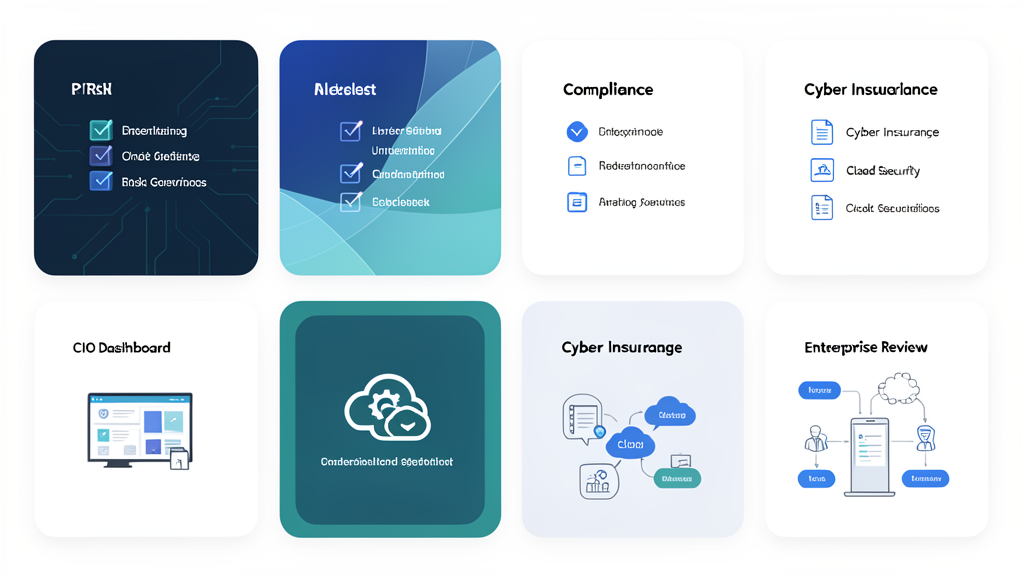
Enterprises should treat cyber insurance readiness as an evidence program. The strongest approach is to map policy questions to actual technical controls, owners, logs, and recurring validation. This gives leadership a clear view of risk and helps IT teams prioritize work that improves both security and recoverability.
| Readiness area | What insurers and executives care about | Recommended enterprise action |
|---|---|---|
| Identity and MFA | Privileged and remote access is protected consistently | Enforce MFA for all users, remove legacy authentication, review exclusions, and prioritize phishing-resistant methods for administrators. |
| Endpoint security | Devices are monitored and suspicious activity is investigated | Deploy managed EDR, define alert ownership, and confirm coverage for servers, laptops, and high-risk systems. |
| Immutable backups | Ransomware cannot easily encrypt or delete recovery copies | Use immutable or logically isolated backup storage, restrict administrative rights, and separate production from backup credentials. |
| Recovery testing | The organization can restore critical services within business expectations | Run scheduled restore tests, document results, validate application dependencies, and report findings to leadership. |
| Incident response | Roles, escalation paths, and decision authority are clear | Maintain an incident response plan, include legal and communications stakeholders, and conduct tabletop exercises. |
| Evidence management | Security claims can be supported during renewal or after an incident | Keep configuration exports, policy screenshots, testing records, asset coverage reports, and change logs in an accessible evidence repository. |
Best practices for enterprise teams
1. Start renewal preparation before the questionnaire arrives
Waiting until renewal compresses security work into a short window. Instead, build a quarterly readiness review. Compare the current policy requirements against live configurations, recent changes, backup reports, and incident response updates. This makes renewal less disruptive and helps finance forecast remediation costs earlier.
2. Validate MFA coverage, not just MFA availability
Many environments have MFA enabled but still carry exceptions. Review global administrators, service accounts, break-glass accounts, VPN users, remote management tools, and third-party portals. Exceptions should be limited, documented, monitored, and reviewed. Where possible, move privileged access toward stronger authentication methods and conditional access policies that reflect device, location, risk, and role.
3. Treat immutable backups as a business control
Immutable backups are not just a storage feature. They are a business continuity control that should be tied to recovery objectives. Enterprises should confirm which systems are protected, how long recovery points are retained, who can change retention settings, and whether backup administration is separated from production administration. SaaS platforms, file shares, databases, identity configurations, and critical application data may require different protection models.

4. Document restore tests in language executives understand
A successful restore test should produce more than a technical note. It should answer business questions: Which service was restored? How long did it take? Were dependencies available? What failed? What changed afterward? This helps operations, finance, and leadership understand whether recovery time objectives are realistic or aspirational.
5. Connect insurance readiness to vendor governance
Managed services, cloud hosting, backup platforms, security monitoring, and SaaS vendors all influence insurability. Vendor contracts and operating procedures should clarify responsibilities for alert review, backup monitoring, incident escalation, evidence production, and recovery support. This is particularly important for enterprises that rely on multiple providers across infrastructure, security, and applications.
Enterprise checklist for the next 30 days
- Identify the policy renewal date and assign an internal owner for cyber insurance readiness.
- Review MFA enforcement across Microsoft 365, VPN, remote management, privileged accounts, and third-party portals.
- Inventory backup coverage for servers, SaaS data, databases, file shares, and business-critical applications.
- Confirm which backup copies are immutable, isolated, or protected from administrative deletion.
- Run at least one documented restore test for a meaningful business system.
- Verify EDR coverage and alert response responsibilities across endpoints and servers.
- Create an evidence folder with configuration reports, backup test results, incident response contacts, and policy documentation.
- Brief finance and executive leadership on gaps, remediation priorities, and renewal implications.
How QuickMSP can help
QuickMSP helps organizations turn security and continuity requirements into practical operating controls. That includes Microsoft 365 security hardening, MFA and access governance, managed backup and disaster recovery planning, endpoint protection coordination, infrastructure hosting, SSL and domain management, and ongoing IT operations support. For enterprises preparing for cyber insurance renewal, the right partner can help translate policy requirements into evidence, remediation steps, and sustainable processes.
Cyber insurance will continue to evolve, but the direction is clear: enterprises must demonstrate control effectiveness, not just control intent.
Ready to assess your cyber insurance readiness? Contact QuickMSP to review your identity controls, backup posture, recovery readiness, and IT operations strategy before renewal pressure turns gaps into urgent business risk.